


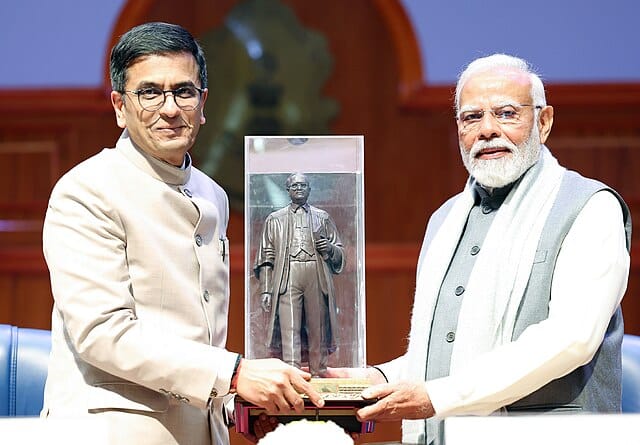
The pitch for a more gender-inclusive and accessible legal profession by the former Chief Justice of India, D.Y. Chandrachud, has renewed interest in ‘feminist jurisprudence’. “I would particularly advise you to incorporate feminist thinking in the way you deal with the law … Initially, I viewed the matters where women were often subjected to the worst of crimes and violations from a straightjacketed perspective, but sitting with a colleague who had more diverse exposure to realities of gender gave me the necessary feminist perspective,” he said recently in his convocation address to students at National Law University.
Every chief justice has a desire for a legacy, which is reflected through their landmark judgments. Given former CJI Chandrachud’s repeated emphasis on feminist jurisprudence and his impressive track record in blending feminist perspectives into his judgments, one speculates whether feminism will be his enduring legacy.
Not only do the former CJI’s comments spotlight the need for greater sensitisation among judges, academics, lawyers and students on feminist scholarship, and make a case for its inclusion in legal education, but they also acknowledge the neglect of traditional jurisprudence in not imbibing feminist theories. The assertion of feminist jurisprudence, as a specialised field in its own right, emerged as a reaction to this historical neglect.
Former CJI’s track record on women’s rights
The former CJI’s call is in line with his track record on delivering progressive judgments on women’s rights issues. To begin with, it comes close on the heels of his recent widely hailed verdict in the abortion rights case. Authoring the verdict for the three-judge bench of the Supreme Court, his expansive interpretation of the right of women, married or unmarried, to make reproductive choices without undue interference from the state, removed the arbitrary distinction between married and single women. This seminal judgment steered women’s reproductive autonomy, dignity, and privacy in the right direction.
Dismantling the entrenched equilibrium of traditional gender identificatory roles, CJI Chandrachud in Security, Ministry of Defence v. Babita Puniya, allowed female Army officers to get permanent commissions and command postings.
Then, in the Joseph Shine case, while striking down Section 497 of the IPC related to adultery, his opinion bolstered the sexual autonomy of women, even within the binds of marriage. The judgment stands out for its extensive research and reliance on several feminist studies.
Further, in the case of Shafin Jahan v. Asokan K.M., in his concurring judgment, he reaffirmed an individual woman’s right to privacy by upholding that an adult’s right to choose marriage or religion falls within her liberty. “The views of the High Court have encroached into a private space reserved for women… in which neither law nor the judges can intrude. The High Court was of the view that at 24, Hadiya ‘is weak and vulnerable, capable of being exploited in many ways’. The High Court has lost sight of the fact that she is a major, capable of taking her own decisions, and is entitled to the right recognised by the Constitution to lead her life exactly as she pleases,” he ruled.
Interestingly, almost four decades back, in the Shah Bano case, his father and former CJI, Justice Y. V. Chandrachud, had risen above retrograde politics in harmonising the rights of Muslim women under personal law with the ideals of the Constitution.
Pending cases in the Supreme Court
Justice Sudhanshu Dhulia’s opinion in the recent Hijab judgment is also noteworthy from a feminist standpoint. Notwithstanding the fact that the main issue in the case was essentially one of religious freedom, Justice Dhulia approached it through the lens of gender justice. “The thing which was uppermost in mind was the education of a girl child. It is a common knowledge that a girl child primarily in rural and semi-rural areas has a lot of difficulties, they have to do daily chores before she goes to school. There are other difficulties as well. The question this Court would put before itself is also whether we are making the life of a girl child any better by denying her education merely because she wears a hijab,” he remarked.
At a time when a number of important cases relating to gender justice are pending in the Supreme Court, the call from the former CJI to reorient the law from a feminist outlook assumes significance.
Presently, two Constitution Bench cases — Sameena Begum v Union of India (constitutionality of certain aspects of Muslim marriage such as polygamy, and its impact on dignity of Muslim women) and Kantaru Rajeevaru v Indian Young Lawyers’ Association (Sabarimala review) were decided in the Supreme Court. These are in addition to the challenge to the constitutionality of the marital rape exception under Section 375 of the IPC (rape) on the grounds that it discriminates against married women who are sexually assaulted by their husbands.
It would be interesting to see to what extent the court pays heeds to the counsel of its new leader.
This piece was originally published in ThePrint on 14 November, 2022 and is republished here with permission for broader academic dissemination. Mohammad Nasir is assistant professor of law at Aligarh Muslim University and author of Syed Mahmood: Colonial India’s Dissenting Judge (Bloomsbury 2022). Shifa reads law at Aligarh Muslim University. Views are personal.