


Sustainable development is not a new concept to Islam. It has existed for centuries in the Holy Qur’an and the Hadith. However, the sustainable development concept may have been recently adopted for government and civic society in the Islamic world. The Islamic perspective embraces that everything on earth is created for humanity and God’s award to people. Islam allows the consumption of the natural environment without involving unnecessary destruction. Muslims are religiously entrusted to prosper the earth via discharging their duties as khalifah (vicegerent). Indeed, their performance will be queried on the Day of Resurrection. Since the 80s, when the concept of ‘sustainable development’ was first introduced, this term has been persistently placed in the context of renewable resources and ecological capabilities to support human life. At this juncture, it is worth considering shifting the paradigm to include the Islamic perspective, especially concerning the built environment professions.
Introduction
In recent years, the world has been overtaken by events as far as the state of the environment is concerned. Several world summits on sustainable development have taken place, such as the 1972 and 1983 ones in Stockholm, 1992 in Rio, 2002 in Johannesburg, and a recent one in 2015, organized by the United Nation known as the United Nation Sustainable Development Summit. These summits have produced resolutions in solving current issues related to sustainable development. The Rio Summit, for instance, has been seen to be the first turning point that suggests the necessity of religious participation as a means of problem solving as included in Agenda 21. The notion of sustainable development is considered as a response to the human need to balance environmental protection with social-economic development. A human need is a variety of different kinds of goods, services in health, education, employment, housing (Sexton, 2000), training, relationships, and also includes the conditions for maintaining an acceptable life standard for all people (Khalfan, 2002). Human need is highlighted by the definition of sustainable development given by the World Commission on Environment and Development (WCED, 1987:43)
“Development that meets the needs of the present without compromising the ability of future generations to meet their own need”.
In an Islamic perspective, the concept of human needs is based on the principles that all the individual components of the surroundings were created by God, and a human being has two basic needs; spiritual needs which is fulfilled through belief or faith in God, and physical needs which is met by making the best use of all resources which God created for him (Ahmed, 2002). Man finds all the essential needs of life such as food, water, air, light, heat, moisture on this planet; the pressure of air, the percentage of oxygen, the elements of soil, are in exact proportion to enable man to live and practice life steadily and orderly (Ibid).
Environmental Sustainability and Islam
Islam propagates the idea of mankind as a trustee (khalifah) of the earth in that trust will be questioned in the Day of Resurrection (Al-Quran, 6:165). Being a trustee, the absolute owner of the universe is Allah the Almighty (Al-Quran, 20:6). This universe is created by Allah the Almighty as a gift (Al-Quran,45:13), a sign of His greatness (Al-Quran,16:65-69) and a place for the sustenance of life (Al-Quran,7:10). The trust must be executed wisely and appropriately as ruled out by Allah the Almighty, failing which the consequences or the impact is on us (Al-Quran, 30:41). The two principal sources of Islam; the Al- Quran and the Al-Sunnah, tell us that the universe is created in due proportion and measurement (Al-Quran, 54:49) and that the resources are sufficient for human consumption as long as the world exist, if it is managed wisely. These two sources also explain to us that human beings are part of nature but are superior to the other creations (Al-Quran, 6:38) because they are bestowed with mental capabilities.
Environment is the complex of physical, chemical, and biotic factors that act upon an organism or an ecological community and ultimately determine its form and survival (Homer and Thomas, 1999 cited in Muinul, 2004). It encompasses natural resources like soil, flora, fauna, water, air, and light that affect living organisms. Islam reiterates that these natural resources have been created by Allah the Almighty with purpose (Al-Quran, 38:27; principally to provide sustenance to man’s life on earth (Al- Quran, 2:60) and further, as a testing-ground for man’s morality in executing his trusteeship role. Sadly, the biosphere is now giving us many signals that it is greatly distressed; that it is struggling to cope with natural resource depletion, ozone depletion, acid rain, ecosystem loss, polluted air, land, river, and ocean (Brunckhorst, 2000 cited in Muinul, 2004).
In Islam, it is very clear when Allah the Almighty reminds human beings not to do evil and make mischief on earth (Al-Quran, 7:56) because the consequences will backfire on human beings themselves. Allah says to that effect that, “mischief has appeared on land and sea because of what the hands of men have done, that Allah may give them a taste of some of their deeds, in order that they may turn back” (Al-Quran, 30:41).‘The taste of their deeds’ is often in the form of environmental disasters and calamities.
Hence, Muslims are religiously bound to manage the environment wisely, manifesting their trusteeship to Allah. In so doing, it charts an environmental ethic and morality in Islam that moulds human attitudes towards the environment. Understanding the carrying capacity of the environment and acting upon it accordingly are very important because men are equipped with mental capabilities to do it compared to the other creations. This effort is regarded as amanah (trust) to mankind that no other creations are prepared to undertake it (Al-Quran, 33:72) except human beings.
Human interactions with the environment could happen in the form of social and economic activities upon which the built environment is constructed. Sustainable development is not a new concept to Muslims. The Qur’an and the Hadith provide the framework for the spiritual and physical welfare of humanity. There are over 500 verses in the Qur’an giving Muslims guidance on matters relating to the environment and how to deal with it, and there are numerous examples from the prophet Mohammed’s life (PBUH) and his sayings, which provide a model for justice and equity (Hassan and Cajee,2002). Mohammed (PBUH) also asked his followers: “Not to harm women, children and the infirm, not to harm animals, destroy crops or cut down trees”. This Hadith is a sort of recognition of the human condition and the value of nature; they have never been separated from each other.
Social Sustainability and Islam
There are six unique elements that are considered by shariah to be key perspectives of Islam in matters of value in society. These four elements are social cohesion, responsibility (Faradh), empowerment (Shura), equilibrium (Al’adl wal ihsan), endowment (Al-Wqaf), and almsgiving (Zakat). Those five elements are main indicators of a sustainable development agenda.
- Social Cohesion (Ummah): Islam has called for society cohesion more than one thousand four hundred years ago (ISESCO, 2005). Shariah emphasises the inspiration of a cohesive society as the process of developing a society of shared values, shared challenges, and equal opportunities.
- Responsibility (Faradh): individual and society have the responsibility to use of welfare in a responsible way (Fakir, 2002). Responsibility from the recognition that comes with human awareness. Humans are responsible as God’s vice-regents (Kalifah) for the care of the earth God said in the Qur’an.
- Empowerment (Shura): Human beings should fully participate in decision-making and implementation in their life (UNDP, 1995). In the Islamic perspective, empowerment means the Shuratic decision-making of all levels of the Islamic society.
- Equilibrium (Al’adl wal ihsan): in which individuals have the freedom to act, but must do so with manner from welfare of the present and future generation (Fakir, 2002), God says: “if you loan God beautiful loan, He will double it in your credit, and He will grant your forgiveness”
- Endowment (Al-Wqaf): Islam has, through its principles, endeavored to fight against poverty. This fight can either occur through providing a source of income for a person, or through government assistance which is unique to Islam and ensures that man is free from the shackles of poverty (ISESCO, 2005). God said in the Qur’an: “Give your kinsman his due, and the needy, and the way-farer, and squander not (your wealth) in wantonness. Indeed, the squanderers are brothers of the devils, and the devil is ever an ingrate to his Lord” (Al-Isra (17), Verse. 26-27: 285).
- Alms (Zakat): Zakat is one of the five pillars of Islam. Zakat provides a vital mechanism for addressing social welfare issues. In shariah, the word zakat refers to the determined share of wealth given by Allah to be distributed among the categories of those allowed to receive it. It is used to mean the action of payment of this share. All Muslims are required to give away at least two and half per cent (2.5%) of their income to the poor people.
Human beings are central to development activities. Socially, human beings are created collective in nature, consisting of males and females, tribes and nations with the purpose of getting to know each other. However, Islam recognizes that the best among them is the most pious to his Creator-Allah the Almighty (Al-Quran, 49:13). This serves as an underlying principle of the Islamic social construct that involves human relationship with the environment. According to Omar (1988, p.288) “by bestowing upon Man such benefits and authority, the Lord honoured Man above all other creatures […] this in turn generates an obligation upon…” .
In relation to the social sustainability concept, Islam develops the Muslims’ personality gradually from an individual that is embodied in the teaching of fiqh al-ibadah (Islamic personal law) which then evolves into the family institution under the purview of fiqh al- munakahat (Islamic family law) and eventually that governs human economic interactions or dealings via fiqh al- muamalat (Islamic commercial law).
Economic Sustainability And Islam
Islam promotes development and growth socially and economically (Al-Quran, 8:53). Islam prohibits poverty as it is close to disbelief (kufr). Islam provides effective means for socio-economic improvement via waqaf (endowment) and zakat (alms) provisions. Indeed, these Islamic economic principles are based on sharing and caring in wealth distribution, likewise any other trading or commercial transactions in Islam. All these economic dealings and transactions among people happen in a space called a city which is created out of land use planning and the built environment. In this regard, Syed Muhammad Naquib al-Attas (1991, p.2) opined that the four significations of din that are indebtedness, submissiveness, judicious power and natural inclination are practicable possibilities only in organised societies involved in commercial life in towns and cities…”. Not only space, the city environment also provides raw materials and facilitates economic activities, for instance, shelter, park, mode of transport, etc.
However, the environment may receive either positive or negative impacts depending on human conduct. Excessive use of nature may cause ozone depletion, the melting of ice-caps, global warming, the rising of sea level and deforestation. Meanwhile, social impacts can be in terms of reduction of quality of life and inequalities. At this juncture, the intricacy of these three elements namely environment, society, and economy, in their own capacity is undeniable. Viewed from the sustainability angle, economic development is a process of utilising natural resources at a specified level for human well-being needs.
Concept Of Sustainability: Conventional And Islam
The present concept of sustainability is not free from critiques. Lack of consistency in its interpretation, intellectual oxymoron, comprehensiveness, and ambiguity (Odeh, 1991; Hilary, H. (n.d.); Lippert, 2004; Shaharir, 2011) are among the critiques against the concept. However, there are those who believe that one should not try to define it too rigorously. To a certain extent, the value of the term does lie in its broad vagueness. It allows people with irreconcilable positions in the environment development debate to search for common ground without appearing to compromise their positions (Arndt, 1981, cited in Sharachchandra, 1991, p.607). Here comes the Islamic worldview to enlighten the matter since Islam lies on the very fundamental sources that is the Al-Quran and the Al-Sunnah (Al-Quran,5:3 and 6:38). In this respect, Kamali’s (1991, p.197) words are worth quoted when he said that it is perhaps true to say that Islamic jurisprudence exhibits greater stability and continuity of values, thought and institutions when compared to western jurisprudence. Westerners based their law on rationality, custom, judicial precedence, morality, and lastly, religion.
Narayanan (2013) state that the role of religion can be played to achieve economic sustainability. The three ways in which religion may play a role in sustainable development are through the values it offers, through its potential for ecological, social, and political activism (based on those values), and through its capacity to enable self-development. The idea was supported by Hossain (2014) in his research finding that the concept of sustainable development is accurate according to religious beliefs. That finding was also supported by Becchetti and Borzaga (2010), who mention that religion can increase economic growth and also environment and economic sustainability.
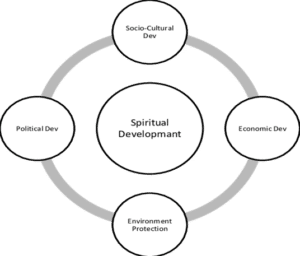
Based on the above-mentioned analysis, the philosophy of sustainable development from the Islamic perspective, can now be defined as sustainable development from Islam that seeks to establish a balance between the environment, economic and social dimensions. It means the balance of consumer welfare, economic efficiency, achievement of ecological balance in the framework of evolutionary knowledge-based, and socially interactive model defining the social justice, shuratice process, charity and zakat are two mechanisms to reduce poverty.
Comparing the present concept of sustainability with the Islamic worldview, it can be said that the differences are: Muslims are religiously bound to manage and prosper the earth under the ‘contract’ of vicegerency. Islam perceives the environment or nature in the bigger context. Islam is a way of life to include every spectrum of human life socially, economically, politically, etc.
Foreword
A review of the present concept of sustainability from the Islamic perspectives has revealed several important points, such as biodiversity has inherent, ecological, and utility values for humankind both as spiritual sustenance as well as material resources. Environment, society, and economy shouldn’t be seen as separate entities in treating the sustainability concept, rather, social and economy are part of the environment. Nature has been created in its natural order, in perfect balance, with extraordinary aesthetic beauty, and human beings are members of the community of nature. Therefore, as a system, there must be good interaction between man and the environment. Finally, nature is a test to mankind, i.e., to what extent and in what manner man will execute his task as trustee of the earth socially and economically. Ultimately, man will be questioned on this trust in the Day of Resurrection because he is religiously bound to it.
The concept of sustainable development took root in 7th century Islam ideology, however, it was not until the 20th century that this ideology was translated into a modern context. Islam, for example, warns in the Holy Qur’an and Hadiths against excess and over extension of natural resources. Islam calls for the collective as well as individuals to refer to God’s Shariah. Islam calls for a sense of responsibility and awareness of the reason for mankind’s creation. All these are natural outcomes of the Shariah rules.
The author is a PhD Candidate at the Faculty of Law, Aligarh Muslim University.
References
Abedi-sarvestani, A., & Shahvali, M. Environmental Ethics : Toward an Islamic Perspective, American-Eurasian J. Agric. & Environ. Sci., (2008).3(4), 609–617.).
Ansari, M. I., Islamic Perspectives on Sustainable Development, The American Journal of Islamic Social Sciences, (1979). 11:3, 394-401
Bruntdland’s Report (1987), World Commission on Environment and Development.
Hasan, Z. (2006).Sustainable Development from an Islamic Perspectices. Mp r a, (2784). http://mpra. ub. uni-muenchen.de/2784/
Abd-Allah, A., (2004), “Mohammed” Prophet and Politician, www.islamlib.com,
Aburounia, H. and Sexton, M., (2004), “Sustainability in Housing from a Social Cultural Perspective in Libya” 5th International Postgraduate Research Conference, April 14th -15th, pp839-856.
Fakir, S., (2002), “The Nation of Public goods, Sustainable Development and Islam”: Islamic Economics: 1-4, www.islamic-world.net/economics/notion
Hassan, A. and Cajee, Z., (2002), “Islam”: Muslim and Sustainable Development, www.imase.org
Islamic legal laws, www.home.swipnet.se/islam/books/islamic-laws.htm
ISESCO (2005), “The Islamic World and the Challenges of Sustainable Development”, Culture and Communication, www.isesco.org.ma
Khalid, F., (2002), “Islam and the Environment”, Social Economic Dimension of Global Environmental Change, John Wiley and Sons Ltd, Vol.5, pp332-229.
Khalfan, M., (2002), “Sustainable Development and Sustainable Construction”, A literature Review for C-SanD, pp1-45.
Matthews, R. and Tlemsani, I., (2003), Zakat and Social Capital: Parallels between Islam and the West, Centre for International Business Policy, pp1-15.
The Holy Qur’an Book
The Translation of Sahih Bukhari Book
UNDP (1995), United Nation Development Program: Human Development Report, Oxford University Press.
WCED (1987) Our Common Future, The World Commission on Environment and Development, Oxford University Press, New York.