

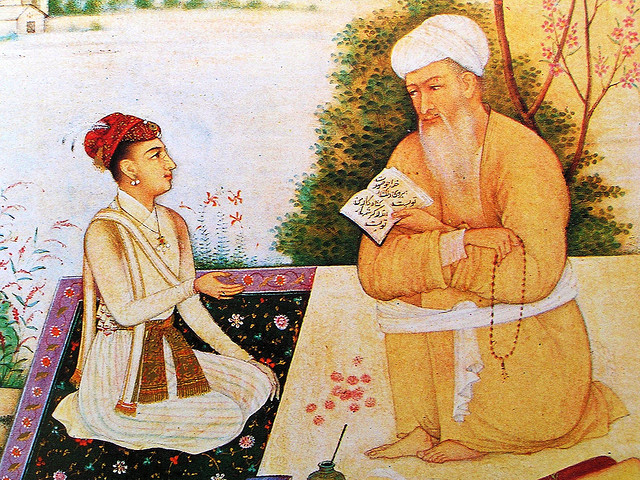
Prince Dara Shukoh, the eldest son of the Mughal king Shahjahan, was a prolific writer. His main area of interest was religion. The various subject matters that the prince initially touched were Tazkira (hagiography), Malfuzat, and Shathiyats of the Muslim holy-men (although his Shathiyat contains the sayings of some of the non-Muslim saints too). But gradually, as he matured, his area of interest acquired a broad canvass and it shifted towards the philosophy of Vedanta and the comparative study of the religions, especially of Indian monotheists and Islam. The Prince, in the process of this drastic shift of the interest, also became an advocate and practitioner of the freedom of expression and belief.
Dara Shukoh was a genuine liberal and progressive prince of India. He was the real flag-bearer of the freedom of expression and belief. This characteristic of the Prince is evident from the study of his very first book, Safinat-al-Auliya. This book is a proof that his mind was free from any biasness or prejudice and ready to accept the new realities based on the principle of Tauhīd. He had not only reserved the space for the twelve Shi’ite Imams in his first book Safinat-ul-Auliya but also wrote the hagiography of pious Muslim women such as the wives and daughters of the Prophet Mohammad (pbuh) and a number of other lady saints. The prince wrote their hagiography at a time when the ladies were being marked with all the disabilities.
By the passing of the time the tolerant attitude of the Prince gradually acquired a very vast canvas as he included in his book Shatahiyat, some of the sayings of non-Muslim Indian Monotheists in the same category of the great and pious Muslim saints. So, in a way, he placed both the Muslim saints and pious non-Muslim Indian Monotheists on the equal pedestal. Then he wrote a book named Majma-al-Bahrain on inter-faith debate and came to the conclusion that there are no real differences between Islam and the religion of the Indian Monotheists except of language. His tolerant attitude then progressed to the level that he, while translating the Upanishads, called it the revealed books and the ultimate source of Tauhid and a great help to decode the secrets of the holy Qur’ān.
Dara does not believe in any kind of extremism. He is of the view that the religions and its followers must possess the quality of accommodating different thoughts and people in its fold as the religion is for the sensible people and it must not differentiate between the peoples based on their faiths. Here the prince comparing the religious fanaticism with the senselessness of the wine says that if the religion and its followers fail to adopt the flexibility of accommodating the new realities in its fold and if they fail to give equal treatment to different people then a cup of wine is better than religion because it does not differentiate the people on the basis of their religious beliefs and provides the same pleasure and taste to everyone. Here the progressive traits of the Prince can be traced as the Prince is pitching for the liberal interpretation of the religious faiths and beliefs.
Dara Shukoh was aware that the fake and the hypocrite religious class was the main obstacle in the path of liberal interpretation of the religion. So despite having faith in religion and revering the genuine religious people, the Prince reviled the fake and the hypocrite religious class. His criticism to the hypocrite Mullas is even more vocal than his great-grandfather, Akbar. He goes on to say that the paradise can only exist at a place where there is neither a hypocrite Mulla nor his unnecessary arguments. So if we want to make our planet a place similar to paradise then, it must be free of Mullas and their unnecessary decrees and arguments. The prince believes that every human being possess some kind of intelligence so, after being educated, one must be given some freedom to choose his acts and express his feelings and opinions. By calling to have this kind of society the prince envisions a society where the people are not directed for their acts by the obsolete religious dictatorship but by the human values.
Bearing a liberal and progressive traits, Dara was not ready to consider a Muslim as a Momin and a non-Muslim (Hindu) as a Kafir just because of their respective Muslim and Hindu names. He was of the opinion that accepting and practicing a religion was a personal matter so the people must not be judged on the basis of the allegiance to their respective religions. They should be judged on the basis of their actions. And if a Kafir who has attained God, seen Him and knows Him, should be recognized as a Momin, similarly a Muslim who has neither attained the God nor seen Him nor knows Him should be considered a Kafir.
A gradual liberal and progressive traits can be seen in the literary journey of Dara Shukoh. He started his literary career by writing hagiographical book of the Muslim saints. Then he added non-Muslim holy men, to a limited extent, in one of his books named Shathiyat. He, after getting more maturity, started taking the help of the non-Muslim saints and scriptures to quench his spiritual thirst. Then he accepted that he liked both the religion of Islam and the religion of Indian Monotheists. Then he further clarified that he had no problem with Kufr as for him both Kufr and Islam had become same. Now as both the Kufr and Islam were same, so the Prince asked the people to follow their own religion.
It was a very important characteristic of Dara that he never used his political power to pressurize the people to accept his thoughts. He also never cared about the political repercussions or backlashes while expressing his liberal and progressive religious thoughts. The genuine propagator of every religions or beliefs, who ever had a chance to meet the prince, thought that the prince had been convinced by their arguments and was ready to accepted their faiths[1]. He is criticized by some of his contemporary literary personalities for not respecting and paying heed to the highest nobles in the field of the worldly affairs but none of them had criticized him for suppressing and prosecuting any one for his beliefs and thoughts.
The writer is Assistant Professor of Persian, English and Foreign Languages University, Hyderabad.